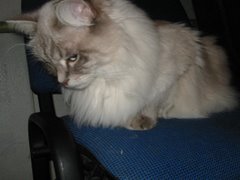
Cat got your nose?: Siberians may be the answer for some allergy-riddled pet lovers
Another article about Siberians being a cat breed suitable for those who suffer from cat allergy.
Cat lovers, this is nothing to sneeze at.
The Siberian breed has become hot news among allergy sufferers who have always wanted a cat but feared the resulting wheezes, sneezes, hives, watery eyes and other problems. But some breeders and allergic owners say that many people who react to other cats can cuddle a Siberian without trouble.
Melissa Young of Arlington has a 2 1/2-year-old nephew, Keegan, whose immunodeficiency disorder makes him allergic to dogs and cats. He's even been hospitalized a couple of times after reacting to cats.
Yet Keegan, who spends a lot of time at the Young house, plays with the Youngs' 6-month-old Siberian without any problem.
"[Keegan] loves the cat, and he cries when he has to leave," Ms. Young says.
Or take 6-year-old Zach Mays of Wylie, who would normally react strongly if he held a cat. But he can play with his 3-month-old Siberian kitten with nothing more than occasional slightly reddened eyes, says his mom, Denise Mays.
Allergy sufferers don't love their Siberians just for the non-sneezy benefits. Siberians are handsome, round-faced, shaggy cats, and breeders and owners even ones without allergies cherish the cats for their affectionate natures.
Pet Lenhard of Melbourne, Fla., said her Siberian, Grigori, seemed "to know I'm sad right now" after her husband died in May 1997. Writing to Florida breeder Lynda Nelson, who sold her Grigori, Ms. Lenhard said: "He washes my arm or face and gives massages in the early hours of the morning when I can no longer sleep."
A Nelson client who does have cat allergies, Ernie Sherman of Ponte Vedra Beach, Fla., wrote in 1997: "It is still somewhat difficult to explain how these beautiful creatures have changed my life. They have provided me with a special feeling of companionship and responsibility. They have all the qualities associated with cats, yet show traits usually attributed to dogs. They exhibit a loyal and protective behavior which other people also notice." Mr. Sherman, who has had lifelong asthma and could not have pets before, now owns four Siberians.
The cats are said to have regal bearing; they also carry a pretty majestic price tag. Breeders charge , depending on age and other factors. However, that price may include not only the cat's basic vaccinations, but spaying and neutering too.
Why many allergy sufferers can own Siberians without swelling like the Goodyear blimp remains a mystery. Ms. Nelson says the cat lacks the allergy-triggering Fel d 1 protein usually found in feline saliva and skin secretions. (Cats spread the allergen around mostly via their dander.)
Not likely, says Dr. James R. Richards, director of the Feline Health Center at Cornell University's highly regarded veterinary school. "I am unaware of any studies that show that any one breed is less allergenic than another, or that one breed produces lower levels of Fel d 1," he says.
A prominent immunologist agrees: "In every cat species that's been looked at, there's been this major allergen [Fel d 1] lions, tigers, Sphinx [hairless house cats]," says Dr. Peyton Eggleston, a researcher in pulmonary immunology and urban asthma at Johns Hopkins University's National Institute of Environmental Health Sciences Center.
The fur is flying
Georgia breeder Kathy Wade cites tests done by an independent Virginia laboratory in 1999. Indoor Biotechnologies, which does sophisticated tests for the presence of allergens, sampled fur from four cat breeds sent to the lab. Ms. Wade says the tests revealed much lower levels of Fel d 1 among Siberians and Abyssinians than typical house cats.
Not so fast, the lab says. In its most recent Web posting, the lab says breeders have misinterpreted the test results and that the Siberian fur actually showed high levels of allergen.
"The company would not provide recommendations on pet ownership based on the results provided under these circumstances," the lab states. "The results do not provide convincing scientific data that Siberian cats are 'hypoallergenic,' and it is unfortunate that they have been widely disseminated on the Web and used by breeders of Siberian cats to promote the breed."
Minnesota's Dvorovoi Cattery offers another theory: "Siberians produce less dander than most cats, probably due to their oily base fur. Since dander is just dry skin, the oils in the fur keep the skin from drying out."
"Interesting thought, but it still seems far-fetched to me," says Cornell's Dr. Richards. And Dr. Eggleston flatly rejects the notion: "One of the sources of dander is the sebaceous glands, which produce the oil."
Some breeders, such as Audrey Oliver of Arizona, scoff at the whole nonallergenic business: "There's no such thing as a hypoallergenic cat. ... It's something that has created a lot of problems for those of us who are trying to be very honest with people."
She advises allergic customers to bathe the cat at least once a week, bar it from the bedroom, vacuum and dust religiously and comb the cat frequently to reduce shedding.
Dallas allergist Dr. Gary Gross further suggests using air cleaners with HEPA filters (and using a HEPA-filter vacuum cleaner as well). He also suggests calling the Allergy Control Products toll-free line (1-800-422-DUST) for detailed information on allergen reduction.
So what's happening?
Can anything, then, explain why Ernie Sherman can have four Siberians and still draw a breath?
Dr. Eggleston offers a couple of possibilities.
"There's a very significant emotional component to allergic disease," he says. "It's not that people are crazy, but in any therapeutic trial for asthma, there's about a 30 percent placebo rate.
"People have done 'challenge' studies where allergy sufferers are given allergen solutions to inhale. With suggestion, you can markedly influence that response." If you believe strongly enough that you won't be allergic, he says, you may still have symptoms. They just won't bother you as much.
He warns, though: "We see a lot of people who are attached to cats who have lots of chronic illness that we are absolutely sure is related to their ownership of cats."
Dr. Eggleston also cites research done by Tom Platts-Mills of the University of Virginia medical school. Dr. Platts-Mills' data shows that "at higher levels of cat allergen exposure, you may actually have less sensitization. He's suggesting that maybe this is why people say they can tolerate their cat. ... I'm not sure about this, but the data is there."
To help allergic prospective customers decide, some breeders will send them a snip of Siberian fur to put inside their pillowcase for a few nights' trial if they can't visit the breeder.
But Dr. Gross calls the pillowcase trial "ridiculous."
"The best way would be to go and spend some time with a person who owns one or to go to a breeder and spend the day there," he says. "Unfortunately, some illnesses such as asthma are worse at night, so even a negative daytime trial might not be definitive."
It may all boil down to this: If you hang around a cat for a few days and it doesn't make you sneeze and wheeze, that's all you need to know.
"If it works for you, it's fine," says Dr. Eggleston. "You don't need lots of explanations."
It worked for Lynda Nelson's client Georgi Brochstein, who sent the breeder this e-mail about his family's new Siberian:
"She has fit in beautifully and has such a place in our hearts. Everyone who comes in contact with her is charmed by her friendly manner and patience around small children. One small child in particular is my 2-year-old grandson, Logan, who has had problems with asthma since he was an infant. The look of pleasure on his face when he has the kitty in his lap and pets her gives us such joy because he couldn't understand before why he couldn't be around animals."
By Steve Steinberg / The Dallas Morning News
Source
Tags:
Articles
0
comments